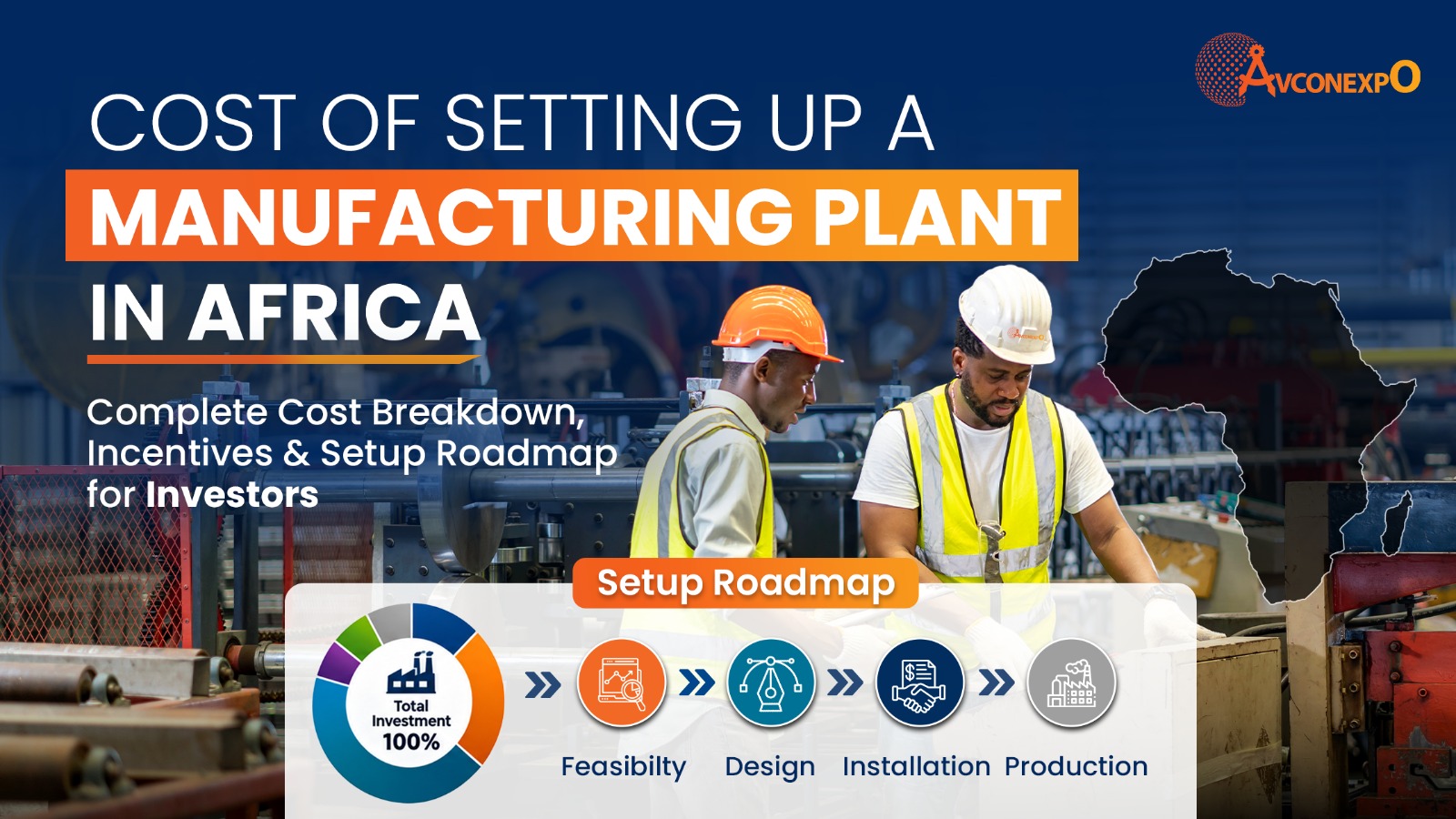
Cost of a Manufacturing Plant Setup in Africa: Complete Cost Breakdown, Incentives, and Setup Roadmap for Investors
Everyone wants a number. "What does it cost to build a factory in Africa?" lands in our inbox most weeks, usually worded as if there's a price list we've been sitting on. There isn't one, and whoever hands you a single figure on the spot is either guessing or selling something.
Think about it for a second. A little water-bottling line and a full dairy plant aren't in the same postcode cost-wise, never mind the same bracket. Build the exact same plant in Lagos and in rural Uganda and the bills still won't match, because the land, the power supply, and what it takes to get your machines to site all behave differently the moment you cross a border.
So in place of a made-up figure, here's what's actually worth knowing: how the spend breaks down, what pushes it around, and which incentives can hand a decent slice of it back. That's the real story on manufacturing plant setup cost in Africa, and it pays to get it straight before you commit a cent.
What actually drives manufacturing plant setup cost in Africa
Forget the sector for a minute. Nearly every manufacturing unit setup, water plant or steel mill, pulls from the same set of cost buckets. The weight on each one shifts, of course. A packaging unit spends its money very differently from a chemical plant. But the buckets themselves don't change, and most manufacturing plant setup budgets sort into the ones below.
If one line tends to run the show, it's the machinery. For most food and agro-processing plants that's where the bulk of the capital goes, and since a lot of the kit is imported, what you pay to land it matters as much as the price on the quote. It's also why lifting a factory setup cost off some Indian or Vietnamese case study will lead you astray. Same machine, maybe. The freight, the duties, and the civil work wrapped around it, not even close.
Why the same plant costs more in one country than another
Two things do most of the damage to any cross-border comparison. First, power. The grid isn't dependable everywhere, so a plant that can't afford downtime ends up building its own backup, generators or solar or a bit of both, and that goes onto the capital bill before you've made a single thing. Second, how far you sit from a port. Industrial equipment for a manufacturing plant in Africa mostly comes in through Mombasa, Dar or Djibouti, and if your site is inland, say Kampala, Kigali or up-country Ethiopia, you pay to haul it the rest of the way. Every shipment.
A few smaller things tug at the industrial plant setup cost as well. Currency, for a start, since your machines are priced in dollars while your sales come back in local notes. Skilled operators, who can be genuinely hard to find for the fancier lines, which turns training into something you budget for rather than trip over. And where you actually put the plant: a serviced plot inside a government park, already wired for power and plumbed for water, usually works out cheaper than a bare field you have to connect from scratch.
Greenfield or brownfield
Projects mostly arrive in one of two shapes, and which one you pick moves the money and the calendar both.
A greenfield factory setup is the build-from-nothing route. Clean site, blank sheet, the plant laid out exactly how you'd want it, no baggage. You also pay for every brick and you wait longer to switch it on. A brownfield factory setup is the other way round: you take a building that's already standing, or a plant that got half-finished or run into the ground, and you bring it back to life. Quicker, usually, and it trims the overall factory setup cost, which is the whole appeal. The catch is you inherit whatever the last lot left behind, so some of the early work is just figuring out what you've actually bought. Reviving a dead unit lives in this camp too, and we do a fair bit of it across East Africa, where perfectly good plants go quiet for reasons that have nothing to do with the machines inside them.
What you're making moves the number
Those sector searches people type say a lot about how capital-hungry each plant really is, and it's only fair to be blunt about the spread.
A mineral water plant cost is mostly filtration, bottling and the packaging line, so a modest setup doesn't need a fortune to get moving. A soap factory setup cost sits a notch higher, and swings on whether you're making laundry or toilet soap, and whether the process runs in batches or straight through. Move to a plywood factory setup cost and it climbs again, once presses, dryers, veneer lines and a steady timber supply come into it. A ghee manufacturing plant cost rides on scale, and on whether it stands alone or hangs off a dairy. And a milk powder manufacturing plant cost is about as heavy as food processing gets, because spray-drying towers, evaporators, cold chain and the utilities behind them simply aren't cheap.
Notice what I'm not doing: quoting a figure for any of them. A number only means something once the capacity, the product mix and the location are fixed, and that's exactly the job of a feasibility study and a detailed project report. It's the step that turns "I'm thinking about a soap plant" into something a bank will lend against.
The incentives that bring it down
Here's where the real figure often gets a lot friendlier, and it's the bit investors forget to ask about. Governments across the region lean on industrial zones and tax breaks to pull manufacturing in, and the savings on tax and duty can genuinely decide whether a project pencils out.
Take Kenya. A plant licensed in an Export Processing Zone has long had a ten-year corporate tax holiday, a full investment deduction on its buildings and machinery, and a pass on VAT and stamp duty, as long as it's export-focused. The newer Special Economic Zone rules ease that, letting you sell more at home and do more besides. And the state keeps building, with big new zones like Vipingo opening under a multi-year promise not to pull the tax terms out from under investors.
Nigeria's the one to keep an eye on, because it's shifting as we speak. The old Pioneer Status Incentive, three years of no corporate tax with a possible two-year top-up, is on its way out. Applications closed in late 2025, and the Nigeria Tax Act swaps it from 2026 for the Economic Development Tax Incentive, which ties the relief to how much you actually invest in priority sectors like manufacturing and agro-processing. So if you're costing a Nigerian project today, model the new scheme. The old one's gone.
Ethiopia built its whole industrial push around purpose-built parks, now moving onto a Special Economic Zone footing. Manufacturers inside the parks have usually had something like ten years free of income tax, duty-free imports on their capital goods and raw materials, an extra deduction for setting up in a less-developed region, and a one-stop shop to spare them some paperwork. Ghana, Tanzania and Uganda run their own versions of the same idea. So wherever you're looking, ask the zone question before you ask the site question.
One caveat, and it's a real one. These rules move, as Nigeria just showed, and almost all of them come with strings attached, on exports, on jobs, on how much you put in. The saving is there. You just have to design for it up front instead of banking on it later.
The order to do it in
The projects that run smoothly mostly follow the same running order, and getting that order right will save you more than any clever cost-cut.
You start with the feasibility study and the detailed project report. They tell you whether the thing makes money and pin a number on the industrial plant setup cost that you can actually defend. Next comes picking the site and sorting the incentives, weighing country and zone against the tax and duty you'll really capture. Then financing, which is where that DPR earns its keep, because lenders at home and abroad want to see one. After that it's the engineering proper: detailed design, then sourcing the right plant and machinery, then the civil build, then installation and commissioning right through to commercial production. The last stretch, handing a running plant over to a trained local crew, is the one that decides whether the whole investment can stand on its own two feet.
Run it in that sequence and you carry far less risk. Buy your machines before the layout's settled or the incentives are locked in, and you'll pay to undo it. We've watched both versions play out.
Where we come in
This is our day job. AVCONEXPO runs industrial projects from the first concept through to commissioning, feasibility and DPRs, engineering and design, vendor sourcing, project management, and the financial and operational side wrapped around it, across agro-processing, edible oils, dairy, food and FMCG. If you're sizing up a new manufacturing plant in Africa, or just trying to pin down a real manufacturing plant setup cost in Africa rather than a figure off a web page, start with a feasibility study built on your own capacity and location. Get in touch and Email us at solutions@avconexpo.com, we'll help you put a proper number together.
Tags