Industrial Engineering Consulting Services in Africa: Reduce Costs, Improve Productivity, and Scale Faster
The short definition of industrial engineering consulting in a simple way is: Industrial engineering consulting is the process of improving factory layouts, production systems, material flow, resource utilization, and operational efficiency to reduce costs and increase productivity.
New equipment almost never fixes a factory on its own, though owners tend to expect it will, and that expectation is really the problem. Money goes into modern machinery, everyone waits for output to jump, and a few months on the deliveries are still late, the lines still stall, and the cost per unit has barely shifted. The machine is doing its job. What's sitting around it isn't.
Across Africa this pattern shows up again and again. On one site, the layout forced operators to walk a few hundred extra metres every shift because storage had ended up at the wrong end of the building. On another, a single forklift ran the same loop dozens of times a day, shifting material that could have sat right next to the line. Nobody files a report about problems like these. They just add cost quietly, shift after shift, until someone finally sits down and totals it up.
That total is usually where industrial engineering consulting earns its fee. An industrial engineer won't stop at one machine or one department. They want to see how the plant hangs together, from the way material moves and gets stored to how the lines are scheduled, how utilities are drawn, and whether any of it copes when volumes double. The aim isn't a factory that works. Most already do, after a fashion. It's a factory that wastes less doing it.
Manufacturing in Africa is growing, and efficiency now decides who wins
Manufacturing across East Africa is on a steep climb. Kenya, Uganda, Tanzania, Rwanda, and Ethiopia are all seeing new plants go up, helped along by government money for industrial parks and a clear push to make more things at home instead of importing them. Food and dairy lead a lot of it, with beverages, pharma, and FMCG close behind. If you're investing in the region, the momentum is real.
Growth brings its own pressure, though. Buyers want faster delivery, more competitors show up every year, and input costs keep rising. Producing more is no longer enough on its own. Factories that want to stay competitive have to produce efficiently, and industrial consulting has become the route a lot of manufacturers take before they commit to big spending. Increasingly they turn to established industrial engineering consulting firms, having worked out that fixing an existing process often pays back faster than buying another machine.
What does the work actually involve in Industrial Engineering
Ask ten people to define industrial engineering and you'll get ten answers. Some picture factory layouts. Others think production planning, or process improvement. The real scope is wider than any of those.
It sits where engineering, operations, and business thinking meet. Every choice inside a plant touches something else. Put a warehouse in the wrong place and material handling goes up. Schedule production badly and machines sit waiting. Skip proper maintenance planning and you get breakdowns nobody saw coming. A manufacturing engineer consultant spends most of their time joining those dots rather than chasing one problem in isolation.
Some of the fixes are almost boringly simple. Move raw material storage closer to the line and you can cut forklift time by hours a week. Rearrange a few machines and a whole handling step disappears. Standardise how a job is done and productivity climbs without a single new purchase. On their own none of these sound dramatic. Add them up over a year and they turn into thousands of recovered working hours and a real dent in operating costs.
East Africa's Manufacturing Sector Is Poised for Growth
-7.5% average manufacturing value added to GDP across several East African economies.
-Kenya, Uganda, Tanzania, Rwanda, and Ethiopia are expanding manufacturing through industrial parks, agro-processing, food processing, and value-added industries.
-This growth is increasing demand for industrial engineering consulting, process optimization, and modern factory planning.
How Does Industrial Engineering Consulting Reduce Manufacturing Costs?
If there's one thing experienced consultants learn fast, it's that every plant leaks money in places the accounts never show.
Take a beverage line where each operator loses three minutes a cycle walking to fetch packaging, because that's how the floor was set up years ago and nobody questioned it. Three minutes sounds like nothing. Spread it across several lines, a couple of shifts, and a full year, and the lost output stops being trivial. A good manufacturing engineer consultant tends to notice this sort of thing within a day or two on site, precisely because it has become invisible to the people who work around it.
The same money disappears into long changeovers between batches, cluttered warehouses, excess stock eating floor space, machines idling for materials, heavy utility bills, unbalanced lines, and rework caused by processes that drift. Any one of them looks minor. Together they're one of the biggest reasons manufacturing costs climb. Which is why the stronger operators don't just track how much they produce.
How Does Industrial Engineering Improve Production Efficiency?
When output slips, plenty of factory managers land on the same instinct, which is to get people moving faster. In our experience the people are rarely the issue. Most of the waste comes from systems that never kept up as the business changed.
If an operator spends half a shift waiting on materials, walking long distances, or working around avoidable stoppages, telling them to hurry doesn't fix anything. Industrial engineering goes at it from the other side. Rather than adding effort, it removes the reasons effort gets wasted in the first place. That's how companies often lift productivity without hiring more people or buying more equipment. The work stops being about doing more and starts being about letting the work flow.
How Industrial Engineering Consulting Benefits Food Processing, Dairy, FMCG, Beverage, and Agro-Processing Industries
Industries with high production volumes benefit the most from industrial engineering consulting and EPC Services. By optimizing factory layouts, production processes, material flow, and resource utilization, manufacturers can reduce costs, improve productivity, and achieve sustainable growth.
- Food Processing: Improve production efficiency, reduce waste, and ensure consistent product quality.
- Dairy Plants: Optimize milk processing, packaging lines, cold chain operations, and energy consumption.
- FMCG Manufacturing: Increase production speed, streamline workflows, and improve inventory management.
- Beverage Industry: Minimize production bottlenecks, optimize filling and packaging lines, and reduce operational downtime.
- Agro-Processing: Enhance value addition, improve raw material handling, and maximize processing efficiency for agricultural products.
Whether you're establishing a Greenfield facility or upgrading a Brownfield plant in Kenya, Uganda, Tanzania, Rwanda, Ethiopia, or across Africa, industrial engineering consulting helps build efficient, scalable, and future-ready manufacturing operations.
Why East Africa needs smarter factories, not just bigger ones
Right across Kenya, Uganda, Tanzania, Rwanda, and Ethiopia, industrial growth has shifted from a government talking point to a genuine commercial opening. New food plants, dairy facilities, packaging units, agro-value chains, and consumer goods factories go up every year. But putting up the building is only the start.
What decides whether a plant is still competitive in five or ten years is how well it runs day to day. Businesses that design in smart flow, plan for expansion early, and invest in efficient systems tend to be the ones still standing as markets shift. It's a big part of why industrial engineering consulting companies have become a fixture on industrial projects across the continent. Sorting problems out on paper, before production starts, costs a fraction of ripping out a bad layout once the machines are bolted down.
Before and After: How Process Optimization Transforms Manufacturing
Every plant is different, but the targets rarely are: less waste, more output, smoother days. Here's the kind of shift the work tends to produce.
And none of it has to be expensive. We've watched a reworked layout or a smarter schedule put more on the bottom line than a whole extra production line would have.
Choosing the right industrial engineering consulting firm Across Africa
Choosing an industrial engineering consulting firm has less to do with brand size than most people assume. What matters is whether the team knows how a working factory behaves once production is actually running. You want people who stay through implementation, not a firm that leaves a report on your desk and moves on.
A few things are worth checking before you sign. Ask whether they've done work in your industry, and whether they can take on Greenfield builds as well as Brownfield upgrades. It helps to know they treat production, utilities, warehousing, and supply chain as one system rather than four separate jobs. And find out, plainly, whether they'll still be around after the design is signed off. The best industrial engineering consulting firms don't stop at naming the problems. They stay on the floor and help fix them, with results you can measure in output, savings, and how the operation runs.
Why Industrial Engineering Consulting Is an Investment, Not a Cost
Plenty of businesses hesitate to bring in consultants because they read it as another cost. The irony is that running an inefficient plant almost always costs more. Wasted movement burns time. A machine waiting on raw material isn't earning. A badly planned warehouse quietly inflates labour and transport bills. Left alone, those small losses compound month after month, and this is the ground industrial engineering consulting companies are built to work on, pulling the losses out before they settle into the daily routine. For a manufacturer that's still growing, that's often the highest-return money they'll spend.
East Africa's Manufacturing Growth Creates New Opportunities
East Africa is rapidly emerging as a manufacturing hub, creating strong demand for industrial engineering consulting and efficient factory solutions.
- Kenya: Investing in food processing and dairy manufacturing.
- Uganda: Expanding banana, cassava, and coffee value-addition.
- Tanzania: Strengthening cashew processing, grain milling, and cassava processing.
- Rwanda: Improving coffee, tea, and agricultural product packaging.
- Ethiopia: Expanding industrial parks and manufacturing infrastructure.
These growing sectors present significant opportunities for manufacturers to improve productivity, reduce costs, and build future-ready facilities across Africa.
Which Industries Benefit Most from Industrial Engineering Consulting?
Nearly any manufacturer can gain something from process improvement, but the impact is biggest where efficiency feeds straight into margin. In practice that's food and dairy processing, beverages, FMCG and consumer goods, pharma, agro-processing, packaging, and the logistics and infrastructure that tie them together. The reason holds up whether you're after more output, a lower conversion cost, or room to grow. Engineering done right keeps paying well past the first year.
Why Is Industrial Engineering Consulting the Key to Long-Term Manufacturing Success in Africa?
There's a real opening here for African manufacturing. Money is flowing into Kenya, Uganda, Tanzania, Rwanda, Ethiopia, Ghana, Nigeria, Sierra Leone, Zambia, and beyond, and the smart move now is to build well, not just build big. Ten years out, the winners probably won't be whoever poured the most concrete. They'll be the operations that stayed lean and made good engineering calls early, back when those calls were still cheap to make.
That, in the end, is what industrial engineering consulting is for. It helps manufacturers see past this quarter's output target and build operations that hold up as demand grows, from sharper layouts and lower running costs to smoother production and room to expand. For anyone planning a new facility or trying to get more out of an existing one, the right partner isn't just solving today's headache. They're setting up for what comes next.
Key Takeaways
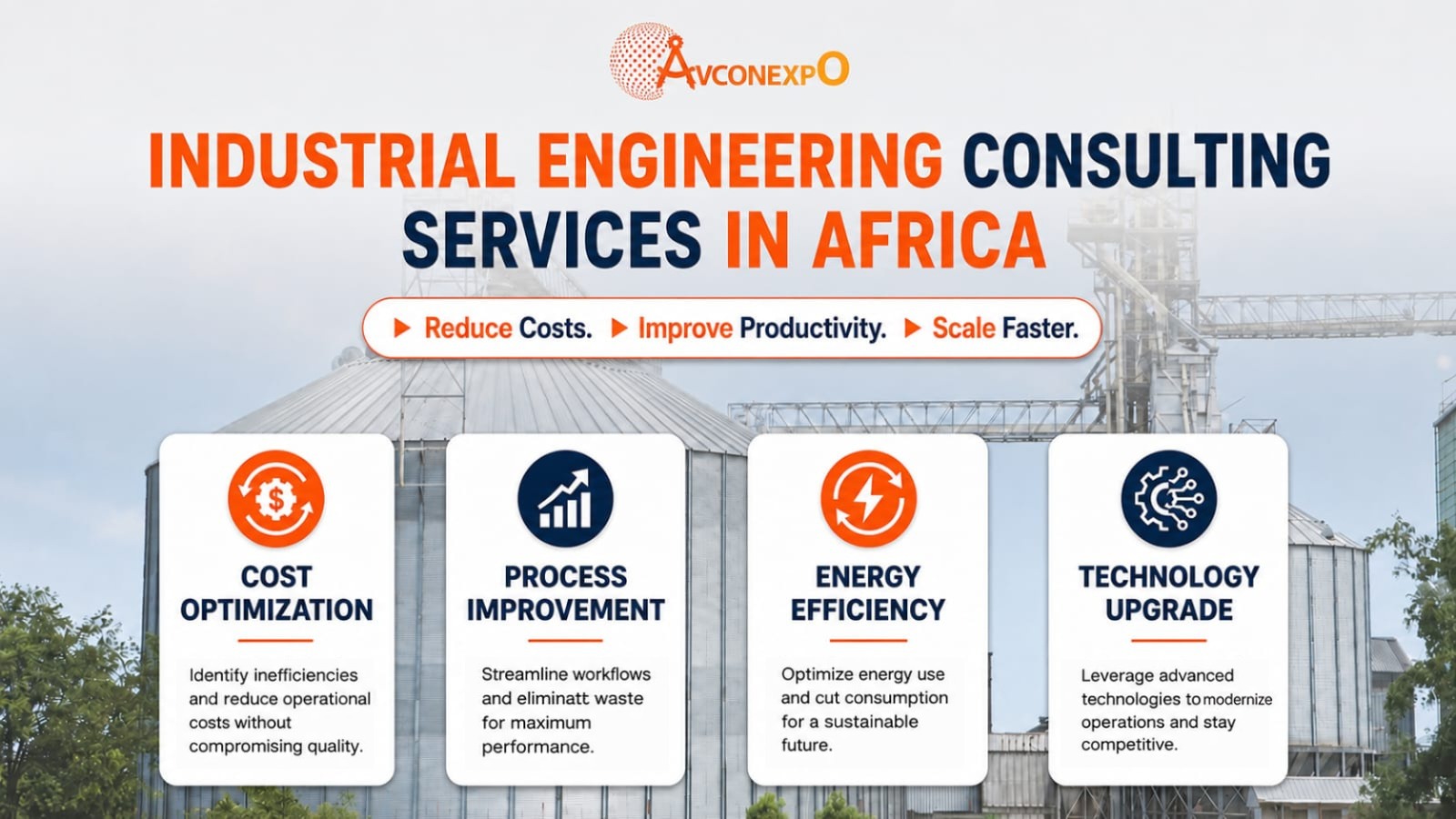
- Reduce costs through smarter factory operations.
- Improve productivity with process optimization.
- Eliminate waste and production bottlenecks.
- Optimize factory layouts and material flow.
- Boost efficiency without major capital investment.
- Best suited for food, dairy, FMCG, beverage, and agro-processing industries.
- Support sustainable manufacturing growth across Africa.
- Partner with AVCONEXPO for end-to-end industrial engineering consulting.
Why choose Avconexpo for the best industrial engineering consulting services in Africa?
If you're looking for an industrial engineering consulting company that delivers practical solutions, not just reports, AVCONEXPO is your trusted partner.
- 30+ Years Industry Experience
- 25+ Countries Served
- Greenfield & Brownfield Specialists
- EPC + Engineering + Supply Chain Under One Roof
- Food, Dairy, FMCG, Agro Processing Experts
- End-to-End Project Delivery
Contact our experts today to discuss your project and discover how we can help you increase productivity, reduce costs, and build a future-ready manufacturing facility. Email us at solutions@avconexpo.com
Tags